


.webp)
Did you know that Delhi’s iconic food joint — Karim’s — famous for its Mughlai delicacies, traces its roots to the late 19th century? It was founded by Haji Karimuddin, son of Mohammed Aziz, who served as a cook in the royal kitchen of Mughal Emperor Bahadur Shah Zafar. Even after more than a century, this family-run restaurant continues to thrive in Old Delhi and has expanded to Khan Market — one of the most expensive retail real-estate hubs in the world.
Where there’s the royal legacy of Karim’s, there’s also the modern innovation of Behrouz Biryani — no royal ancestry here, just the entrepreneurial grit of new-age founders who helped shape the cloud-kitchen revolution in India.
The Rise of Cloud Kitchens in India
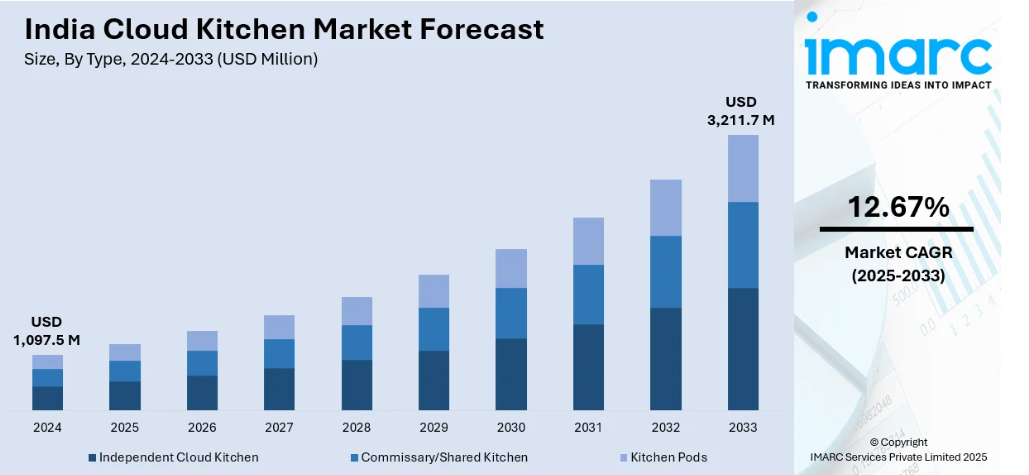
India’s cloud-kitchen market is continuing to scale rapidly. According to IMARC Group, the market was worth around USD 1.10 billion in 2024, and is projected to reach USD 3.21 billion by 2033, growing at a CAGR of ~12.67% from 2025-2033. (Imarc group)
The country now hosts over 20,000 cloud kitchens, with Delhi-NCR emerging as one of the largest hubs for delivery-only restaurants.
As the market matures, several players are realigning their strategies. For instance, Swiggy sold its cloud-kitchen division “Swiggy Access” to Kitchens@ in 2023 to sharpen its focus on profitability — a move that reflects broader consolidation trends in the sector.
Key insights:
- The low-capex, delivery-first model allows rapid scaling for F&B entrepreneurs.
- Integration of AI-driven demand forecasting and supply-chain analytics is becoming essential for profitability.
Investors’ Appetite for Food-tech
Despite this consolidation, angel investors and venture funds continue to show strong confidence in food-tech and delivery-infrastructure startups. As stated by Statista (2025), the online food-delivery market in India is projected to generate USD 54.97 billion in 2025 and reach nearly USD 102 billion by 2030, growing at a CAGR of 13.26%.
This expanding ecosystem is attracting early-stage capital towards tech-enabled profitability models. Platforms like Mumbai-based Ghost Kitchens India help restaurants and cloud kitchens unlock additional revenue streams by integrating multiple virtual brands into existing kitchen setups. Globally, the model has scaled fast with players like Denver-based Nextbite and Orlando-based Virtual Dining Concepts, which have collectively raised over USD 200 million to expand and optimize virtual-brand operations.
Investors today are increasingly prioritizing startups with strong backend technology and asset-light scalability, focusing on those that drive efficiency rather than asset accumulation. Profit-enabler platforms that improve kitchen utilization and offer brand-licensing opportunities are seeing rising valuations. This signals a shift in how investors now view value creation in food-tech.
The Challenges
- Standing out in an increasingly crowded brand landscape
- Maintaining consistent supply-chain efficiency at scale
- Balancing growth with sustainable unit economics
- Managing rising input costs without compromising quality
- Integrating technology effectively across operations
Conclusion
India’s food-tech ecosystem is at an inflection point. From the timeless tandoors of Karim’s to the tech-driven biryanis of Behrouz, consumer demand has never been stronger — and that’s the real opportunity. The path forward lies in blending heritage with innovation, where tradition meets technology and smart capital fuels the next wave of culinary creativity.



.png)


.png)

.png)


.png)
.png)
.png)
.png)